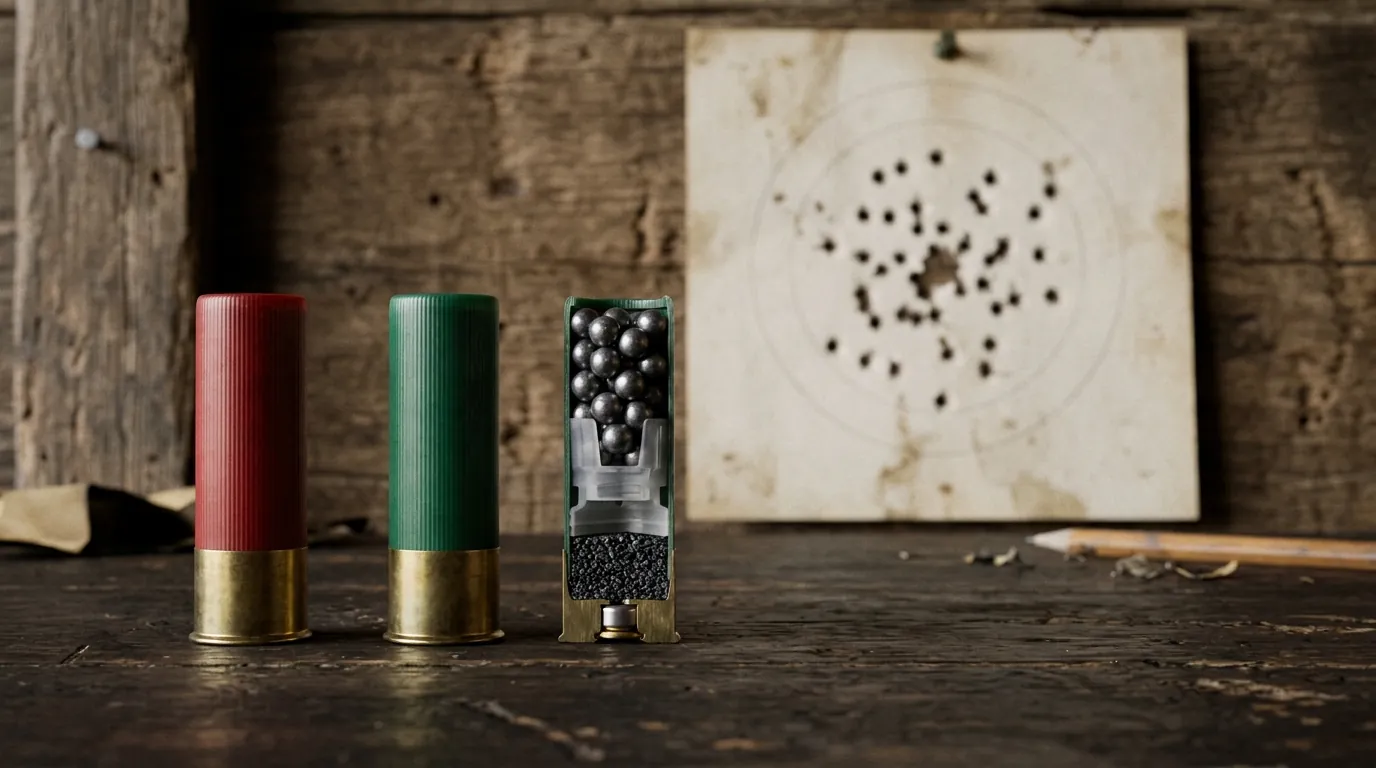
For home defense, the shell matters as much as the shotgun. Here's what the common buckshot sizes are, how deep they go, and why birdshot is a poor choice indoors.
The three common buckshot sizes
| Load | Pellet diameter | Typical pellet count (12 ga) | Reported gel penetration |
|---|---|---|---|
| 00 buck | .330"[1] | usually 8–9[2] | about 18–20"[2] |
| #1 buck | about .30"[2] | 12–16[2] | about 15–18"[2] |
| #4 buck | .240"[1] | about 21–28[2] | "on the very edge of adequate" at typical speeds[2] |
Don't mix up #4 buckshot with #4 birdshot — birdshot pellets are much smaller.[1]
The 12–18 inch benchmark
A 1989 FBI wound-ballistics paper set the familiar standard: at least 12 inches of penetration in soft tissue, with up to 18 inches preferred.[3] It was written for handgun bullets, but it's widely used as a yardstick for defensive buckshot too. By the reported numbers above, 00 and #1 buck both reach it; #4 buck is borderline.
Why not birdshot?
In one published gel test, most #7½ birdshot pellets stopped at about 4¾ inches at 10 feet and about 4 inches at 15 feet[4] — far short of the 12-inch benchmark. Birdshot is great for clays and birds. It's not a defensive load.
Reduced-recoil buckshot
"Low recoil" buckshot runs slower — roughly 1,100–1,200 fps — and is easier to control, which helps with fast follow-up shots.[2] The catch: some semi-auto shotguns don't cycle reliably with low-recoil loads, so test yours with the exact load before you trust it.[2]
What "FliteControl" means
Federal's FliteControl wad brakes from the rear so the pellets stay together longer after leaving the barrel, giving tighter patterns.[5] Tighter patterns mean fewer stray pellets at room distances. Whatever you choose, pattern it on paper at the distances inside your home.
Any load that penetrates enough to stop a threat can also go through interior walls. Think about who's on the other side of every wall in your house, and plan your positions around that.
Where to buy
Compare current buckshot prices on our sister site BulkAmmoFinder.com. Buy enough to practice with the same load you keep loaded.
FAQ
Is 00 buck or #4 buck better for home defense?
By the reported gel numbers, 00 buck (about 18–20 inches) and #1 buck (about 15–18 inches) meet the common 12–18 inch penetration benchmark, while #4 buck is described as borderline at typical speeds.
Is birdshot good for home defense?
No. In a published gel test, most #7½ birdshot pellets penetrated only about 4–5 inches at 10–15 feet, well short of the 12-inch benchmark.
Will low-recoil buckshot work in my semi-auto?
Not always. Some semi-auto shotguns don't cycle reliably with low-recoil loads. Test your exact load in your gun before relying on it.
Sources
- Hornady
- Lucky Gunner Lounge (secondary)
- FBI Academy (archived copy on Internet Archive)
- OutdoorHub (secondary)
- Primary Arms product listing (Federal description) (secondary)
Last checked October 18, 2026. Spotted something out of date? Send a correction.